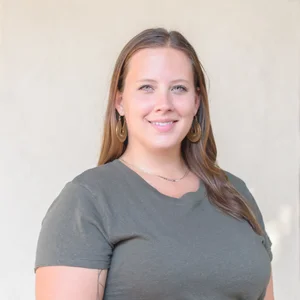
Get to Know Jayme Kelton
We are so excited to introduce Jayme Kelton, Licensed Professional Counselor (Illinois), Dance/Movement Therapist, and Mental Health Coach. If you’ve landed here, we’re really glad you did.
In addition to what you’ll find on her About Me page, here’s a chance to get to know her a little more.
Why did you become a therapist?
I’ve always been drawn to the ways people express what they’re feeling, even when they don’t have the words for it.
That curiosity is what led me to dance and movement first, and eventually into therapy. I began to notice how much our bodies communicate and how often those signals get overlooked.
Over time, I realized that healing isn’t just something we think through, it’s something we experience in the body. That led me to specialize in dance/movement therapy and somatic approaches, where people can process, express, and reconnect in ways that feel more natural and accessible.
I wanted to create a space where people don’t have to have it all figured out or perfectly explained to begin.
What are your favorite parts about being a therapist?
I really value helping people find tools that actually fit into their lives, especially tools that go beyond just thinking differently and include how they relate to their body, their emotions, and their patterns.
I also appreciate what I learn from the people I work with. There’s something meaningful about being in a space where people are showing up honestly and beginning to notice things they may not have had language for before.
What does your approach look like?
My work is grounded in the belief that the mind and body are constantly communicating.
I use a blend of talk therapy, somatic awareness, movement, mindfulness, and creative expression to support people in:
Reconnecting with their bodies
Noticing physical sensations connected to emotions
Processing experiences that don’t always have words
Building practical, sustainable coping strategies
Growing self-awareness and resilience
Because sometimes talking about something isn’t enough. We have to experience and feel our way through it.
Why movement?
Many of us have learned to disconnect from our bodies, especially when life feels overwhelming or when we’ve had to cope in difficult situations.
We are taught stay busy or to push through. We are oftentimes conditioned to override what we’re feeling.
But despite this mind-body disconnect, however distracted we become, as has become common language now, the body keeps the score.
Movement offers a way to gently come back into connection with yourself. In dance/movement therapy, this might look like:
Noticing posture, tension, or breath
Exploring small, intentional movements
Using the body to express something that doesn’t have words yet
Practicing regulation through rhythm, grounding, and awareness
Dance therapy is not about performing, being a dancer, or using movement to replicate choreography.
Dance/movement therapy may include more creative and “dance” like expression but it is also about tuning in, noticing, and allowing your body to be part of the healing process.
Who do you typically work with?
I work with individuals navigating:
Trauma and life stressors
Anxiety and emotional overwhelm
Experiences connected to addiction
Transitions, growth, and identity
Across community and clinical settings, I’ve had the opportunity to work with people as they begin to reconnect with themselves in both mind and body.
One thing I know to be true is that healing looks different for everyone.
What is it like to work with you?
My approach is trauma-informed, relational, and grounded in curiosity.
Some sessions may look more like conversation. Others may include mindfulness, body awareness, or gentle movement depending on what feels right for you.
There’s no pressure to move in a certain way or to do anything that feels uncomfortable.
I aim to create a space where you can slow down, notice what’s happening internally, and explore it at your own pace.
How do you practice your own self-care?
Movement is a big part of my life, both personally and professionally. I enjoy dancing and finding different ways to stay active.
I also value time with my family, especially my two kids, and opportunities to travel or explore something new.
Staying connected to my own body and creativity is something I come back to often.
What’s something you wish more people knew about therapy?
I wish more people knew that you don’t need to have the “right words” to start.
There can be a lot of pressure to explain everything clearly, and that can keep people from reaching out. Therapy can begin with simply noticing what you’re feeling, physically or emotionally, and building from there.
If you weren’t a therapist, what would you be doing?
I would still want to be doing something creative and expressive.
I would probably be connected to movement or a space where creativity, the body, and connection are part of everyday life.
Work With Jayme
If something here resonated with you, I’d love to connect.
I offer:
Individual therapy sessions
Movement-based and somatic therapy
Mental health coaching and skill-building
Whether you’re feeling stuck, curious about therapy, or simply wondering if something different could help, we can explore what feels like the right next step together.
You don’t have to have everything figured out before reaching out.
If you’re interested in working together, you can connect to learn more, ask questions, or get started.